
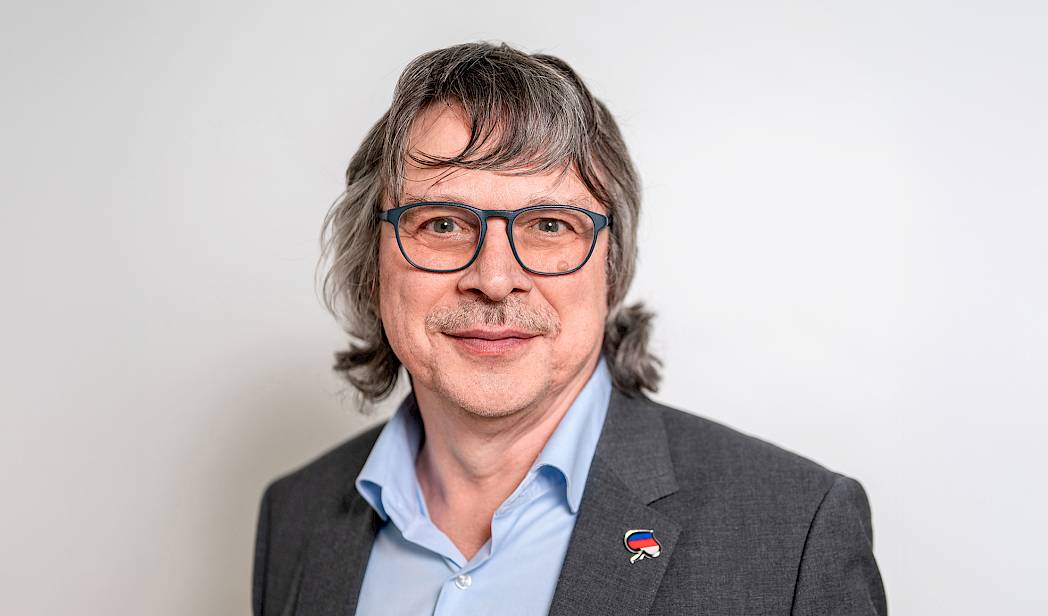
Foto: Domowina Macedonian Newspaper “Ilinden”: As Spokesman of the AGSM, could you tell us about the history, mission, and development of this working group within FUEN? What are its most important achievements to date, and how does the AGSM contribute to protecting the national, linguistic, and cultural identity of Slavic minorities throughout Europe? Dr. Hartmut Leipner: The Working Group of Slavic Minorities (AGSM) was founded in 1996 under the umbrella of FUEN, on an initiative from Lusatia. Its founding idea still guides us: in a Europe marked by tensions, Slavic minorities should focus on what unites them. In the AGSM, communities whose peoples have faced each other in political and even armed conflict work together in dialogue and solidarity. In 2017 the FUEN Coordination Office took over our coordination, and we have had stable support from the German Federal Ministry of the Interior. Since then the AGSM has grown considerably. Today it unites 32 member organisations from 11 countries and is FUEN’s largest working group. We meet twice a year, at the FUEN Congress and at our annual seminar. A different member community hosts the seminar each time. The most recent seminars were held in Gorica/Gorizia and Tirana. We protect the national, linguistic and cultural identity of Slavic minorities in three ways: Exchange. We share experience between communities. Advocacy. We bring their concerns through FUEN to the Council of Europe, the European Union and the United Nations. Solidarity. We stand by communities under pressure, especially the smaller ones. Our conviction is simple: minorities are not a problem to be managed. They are an added value for society and democracy. Macedonian Newspaper “Ilinden”: Despite the European legal instruments and mechanisms for protecting national minorities, many minorities continue to face challenges regarding the recognition of their identity, the use of their mother tongue, education, political representation, and participation in public life. What do you consider to be the most urgent issues, and what more should European institutions and national governments do to address them? Dr. Hartmut Leipner: The European instruments, above all the Framework Convention for the Protection of National Minorities and the European Charter for Regional or Minority Languages, are valuable achievements. But their weakness is implementation. Too often, recommendations from the Council of Europe’s monitoring bodies remain on paper, and not every state has ratified both instruments. Rights that exist only formally do not protect anyone. I see four urgent issues: Language transmission. Many minority languages are no longer passed on naturally within families. Without bilingual education from kindergarten to school leaving, there is no future for these languages. In Lusatia, where I come from, Sorbian schools struggle with a serious shortage of qualified teachers. Recognition. Some communities are still denied recognition of their identity, or are reduced to mere “ethnic groups”. Participation. Too few minorities have real political representation and a voice in the decisions that affect them. Visibility. Minority languages must be present in the media and in the digital world, not only in folklore. The European Union has no coherent framework for minority protection. The Commission’s rejection of the Minority SafePack initiative was a missed opportunity. The EU should make minority protection a lasting part of its policy and funding, not only a criterion for candidate countries. National governments must implement the Council of Europe’s recommendations consistently, secure long-term funding for minority institutions, and involve minorities as partners, not as petitioners. Minorities do not ask for privileges. They ask for the conditions to remain who they are. Macedonian Newspaper “Ilinden”: The Macedonian Association “Ilinden”-Tirana has been a full member of FUEN and the AGSM for 11 years. How do you assess this cooperation? Dr. Hartmut Leipner: I assess this cooperation very positively. Over eleven years, the Macedonian Association “Ilinden”-Tirana has become a reliable and committed member of FUEN and the AGSM. Its representatives bring the experience of a community that has long fought for recognition and for the right to use its mother tongue. This experience enriches our whole network. For the AGSM, the membership of “Ilinden” has a special meaning. It shows that our working group reaches far beyond Central Europe and includes the Slavic communities of the Western Balkans. Their concerns, such as education in the mother tongue, the preservation of cultural heritage and fair representation in public life, are shared by many of our members. The high point of our cooperation so far was the 29th AGSM Seminar in Tirana in June 2026. It was the first time we met in Albania, and it happened in our 30th anniversary year. “Ilinden” organised the seminar with great care and warm hospitality. It gave members from across Europe a direct view of the situation of the Macedonian minority and of Albania’s path towards the European Union. We were also deeply honoured when “Ilinden” presented the AGSM with its award. Macedonian Newspaper “Ilinden”: Albania has a legal framework for the protection of national minorities and has ratified international instruments in this field. Nevertheless, the effective implementation of linguistic, educational, cultural, and political rights remains essential for every minority. How can FUEN support the Macedonian Association “Ilinden”-Tirana in ensuring the practical implementation of these rights? Dr. Hartmut Leipner: FUEN can support “Ilinden” in several practical ways: International monitoring. FUEN can help “Ilinden” bring well-documented concerns to the Council of Europe’s monitoring bodies. Albania’s EU accession process is also important here. The European Commission assesses minority rights in its annual reports on Albania, and FUEN can make sure that the voice of the Macedonian community is heard in Brussels. Exchange of good practice. Many FUEN members have long experience with bilingual education, minority media and the use of minority languages in public administration. Sorbs, Carinthian Slovenes and others can share what has worked for them and what has not. “Ilinden” does not have to start from scratch. Organisational strength. Implementation is often decided locally, in schools, municipalities and administrations. FUEN can help “Ilinden” build its capacity through training, project partnerships and access to European funding programmes. Dialogue. Rights become reality where minorities and governments speak to each other on equal terms. FUEN can encourage and accompany this dialogue with the Albanian authorities in a constructive spirit. Macedonian Newspaper “Ilinden”: Considering the Macedonian Association “Ilinden”-Tirana’s 11-year membership in FUEN and its cooperation within the AGSM, which areas should be prioritised in the coming years? Could this cooperation develop into long-term joint projects to protect the language, culture, identity, and rights of the Macedonian national minority in the Republic of Albania? Dr. Hartmut Leipner: Yes, I am convinced that this cooperation can grow into long-term joint projects. Eleven years of membership have built trust. Now we should make it more structured and sustainable. In my view, four areas should come first: Education in the mother tongue. This is the key to the future of any minority. Joint projects could support Macedonian-language teaching, teacher training, modern learning materials and exchanges with teachers from other Slavic minority schools in the AGSM. Young people. A language survives only if young people use it with confidence. Through FUEN’s youth partner, the Youth of European Nationalities, young Macedonians from Albania can meet peers from other minorities, learn from them and become the next generation of leaders. Cultural heritage and media. The cultural heritage of the Macedonian communities, for example in Mala Prespa and Golo Brdo, deserves to be documented and passed on. Media and digital content in Macedonian can bring the language into everyday life. Here we can build on the AGSM’s own experience, such as our film about the Carinthian Slovenes. Rights and participation. “Ilinden” and FUEN should jointly follow how minority rights are implemented in practice and strengthen the participation of Macedonians in public life. Such projects need partners and stable funding. Within the AGSM, “Ilinden” will find experienced partners, and FUEN can help secure the necessary support. The aim is clear: projects that outlast single events and strengthen the Macedonian community in Albania for the long term. Macedonian Newspaper “Ilinden”: FUEN is one of the leading European organisations representing the interests of autochthonous national minorities. What mechanisms does the organisation use to assist its member communities when their rights are not implemented in practice? Can we expect new initiatives from FUEN to strengthen the legal and institutional protection of Macedonian minorities in Europe? Dr. Hartmut Leipner: FUEN has several tools to help member communities whose rights are not respected in practice: Monitoring and…
Exclusive Interview for the Macedonian Newspaper “Ilinden”: Dr. Hartmut Leipner, Spokesman of the Working Group of Slavic Minorities (AGSM) and Vice-President of the Federal Union of European Nationalities (FUEN)
4
претходен текст
